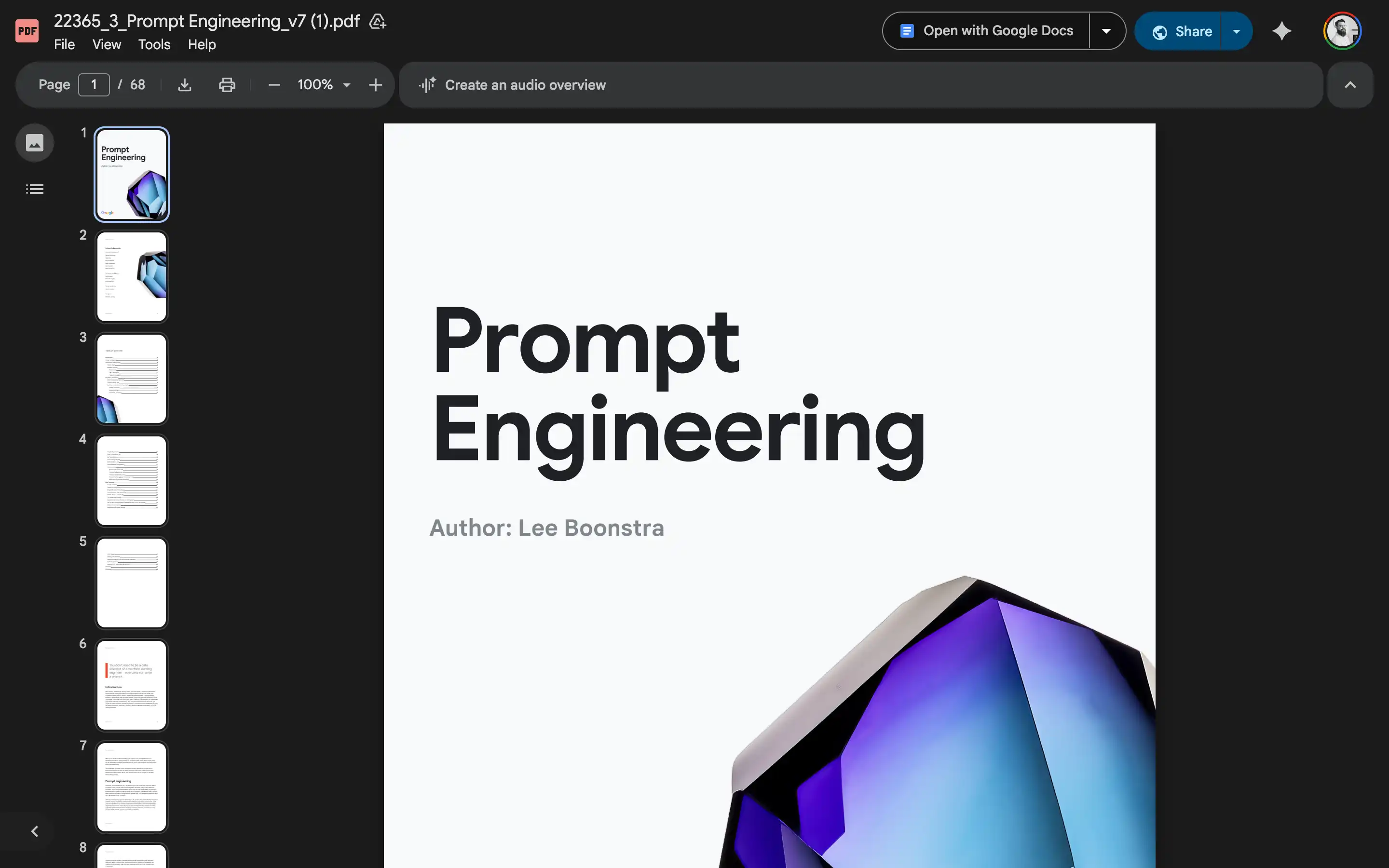
“Prompt Engineering” is a 60+ page whitepaper by Lee Boonstra (Google) that explains how to design effective prompts and configurations for large language models, with a primary focus on Gemini in Vertex AI but principles that generalize to other APIs. It starts by framing LLMs as next-token prediction engines, then walks through how prompt wording, structure, and context interact with model settings such as output length, temperature, top-K, and top-P. The guide explains when to favor more deterministic vs. creative outputs and how different sampling settings combine, giving suggested starting values and trade-offs for reliability, cost, and latency.
The core of the document surveys a range of prompting techniques: zero-shot, one-shot, and few-shot prompts; system, role, and contextual prompting; step-back prompts; chain-of-thought, self-consistency, and tree-of-thoughts; ReAct (reason-and-act); and automatic prompt engineering. Later chapters focus on code-related prompts (writing, explaining, translating, and debugging code), multimodal prompting, and a set of best practices such as providing clear examples, specifying output formats, using variables, experimenting with styles, adapting to model updates, and documenting prompt iterations. Overall, it serves as a structured reference for practitioners who want a deeper, research-informed overview of how to control LLM behavior and evaluate prompt quality.